A Day at Keeneland

I was thrilled to hear that Keeneland will be hosting the 2015 Breeders’ Cup. It is classic venue  for horse racing, similar to the how the great baseball parks reflect that sport’s golden era.  I was fortunate enough to visit the track in 2005, while moving cross-country. I arrived from Louisville in the early afternoon and spent the next few hours wandering around the grounds, visiting the barns, and leaning on the rail at the training track like a 40’s railbird for a good half-hour. I eventually made it to  the grandstand, where I literally was the only one there.  It was wonderful.

At the time, I had been serious about my handicapping for about a year and had already read all the classics:  Beyer, Brohamer, Cramer, Quinn, Ainsle, Meadow. But, I hadn’t spent much time around the actual racetrack, instead watching most of my racing on ADW streams on my laptop. That day at Keeneland was the first time I felt a connection to the majesty of horse racing. I ended up spending the remainder of the day sitting in that grandstand thinking about racing and life. I finally left after dark, and I’ve wanted to go back every day since.

Reviewing Maiden Claiming Week: Favorites, Plays, and Surprises

This past week, the Race of the Day focused on the maiden claiming ranks from around the country. There was still a good variety of races, with three different surfaces, four different tracks, three different distances, and, of course, a race for two years olds to cap it off.  Let’s review by looking at the charts, along with the predicted/actual favorite, whether I believed the favorite was risky, what plays I suggested, and the biggest surprise out of the race.

I track these because I like to assess the accuracy of  both my predictions about the public’s behavior and whether the favored horse is beatable.  Sometimes, these indicators can tell you more about your handicapping than temporary fluctuations (both positive and negative) in your ROI.  Notable surprises are both interesting, but also useful in future handicapping. Enjoy!

Monday, June 16:  Presque Isle Downs, 7th race, 6½ Furlongs, Dirt, PA-Bred Maiden Claiming $12.5K, 3 and up, Purse: $13,000.

  • Predicted and Actual Favorite:  1/1A   Little Drummer/Burning Point 2/5
  • Favorite Status:  Beatable
  • Play/Rationale:  Textbook Blues (9/2) and Mission Man (9/1) as second time against artificial surface with improvement in first effort.
  • Winner:  Favorite
  • Notable Surprise:  Money Eyed Boy’s sire, Jet Star, had his first starter on artificial surface, which could bode well for the Pennsylvania sire at Presque Isle.

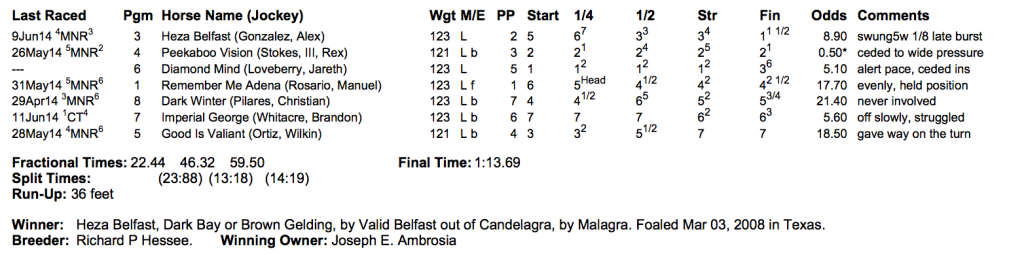
Screenshot 2014-06-21 10.23.12 Wednesday, June 18:  Mountaineer Racetrack,1st race, 1 Mile, Dirt, Maiden Claiming $5K, 3 and up, Purse: $8.1K.

  • Predicted and Actual Favorite:  Peekaboo Vision (1/2)
  • Favorite Status:  Beatable
  • Play/Rationale: Diamond Mind at 5-1 as a well-meant first-time starter with heavy risks on other contenders
  • Winner: Heza Belfast
  • Notable Surprise:  Hezabelfast was 0 for 26 with six seconds and nine thirds.  But he just rolled on by Peekaboo Vision and Diamond Mind, who had led in the stretch before tiring late.  That’s horse racing!
Screenshot 2014-06-21 10.35.32 Thursday, June 19:  Belmont Park, 5th race, 1 Mile, Inner Turf, Maiden Claiming $40K, 3 and up, Purse $41K.

  • Predicted and Actual Favorite:  Corinthian Summer (Even)
  • Favorite Status:  Beatable
  • Play/Rationale:  Shoot for the fences — Azorian and Hooping — with the beatable favorite taking way too much money.
  • Winner: Plated
  • Notable Surprise:  The “extreme cutback” from over 2 miles by Plated.  For those curious, FX is twice a year day-long meet in Charlottesville, VA for jumpers.  Learn something new every race!

Screenshot 2014-06-21 10.37.18 Friday, June 20:  Lone Star Park, 6th Race, 5 Furlongs, Maiden Claiming $20K, 2 year olds, Purse $12K.

  • Predicted and Actual Favorite:  Prime Pilot
  • Favorite Status:  Very Legitimate
  • Play/Rationale:  Prime Pilot — legitimate favorite that was playable down to even money.  Combine with Pick 3’s and Pick 4’s.
  • Winner: Favorite
  • Notable Surprise: The stronger part of the #1 entry, Nonobaby, was scratched by the track vet before the race, making it easier for Prime Pilot to romp.

Screenshot 2014-06-21 10.41.59 All charts are: Copyright 2014 Equibase Company, LLC.

Rethinking Multi-Race Exotics

Having a ticket crafted out of various combinations of your “A”, “B,” and “C” rated horses is all the rage in wagering. Generally, you hit your ticket if all of your A’s win, or some combination of A’s & B’s, or A & C’s. Explained by Steven Crist in “Exotic Betting,” (full review here) and the basis for the DRF wagering calculator, this method lets you go deeper for less money in pick four, pick fives, and pick sixes. It is colloquially known as the “Chinese Menu” approach, in reference to Chinese food family-style menus that let you choose a couple of items from column A and B, respectively.

This method — now considered the mainstream approach — is flawed from a value perspective.  By eliminating tickets with multiple longshot horses, you cut out the rarest combinations and those that will pay the most. Many of these combinations can potentially scoop the pool at smaller tracks. Getting into these “soft spots” is where the outsized payoffs are. The proponents of the Chinese Menu approach need to show that the money saved by leaving these combinations off the tickets makes financial sense by giving up chances at year-changing payouts.  It is my experience that they do not.

I prefer the combinations of different levels of “unlikely” in order to maximize return. The greatest payoffs occur when you can combine “very unlikely” (in the eyes of the public, but still a contender) with “only slightly unlikely.”  The tighter the multi-race exotics, the better (Daily Double over Pick 3/Pick 3 over Pick 4 and 5), with the maximum amount of money pushed onto your opinion.  That said, there are many “soft spots” that can bring about outsized returns throughout the longer multi-race exotics.  Knowing how to play these well can make a significant difference in your bottom line.


Handicapping Perspectives

A player must develop their own style independent of the mainstream and learn how to adjust this style to consistently fade the public. The best way to accomplish this is to be introduced to a number of different models of horse racing simultaneously. By doing this, the player can evaluate and compare the effectiveness of different models and find the perspective that works best for them.

What perspectives should the beginning horseplayer be introduced to?  I suggest five, with the pre-eminent author in parentheses.

  • Value Handicapping (Mark Cramer)
  • Speed Handicapping (Andrew Beyer)
  • Class Handicapping (James Quinn)
  • Running Line Handicapping (Tom Ainsle)
  • Pace Handicapping (Tom Brohamer)

This is not an exclusive list of all models of a horse race. But it is, nonetheless, an excellent starting point for beginning to understand the races.

Simplying Belmont Stakes Noise

You’ll hear a bunch of handicapping noise the next few days.  Everybody is going to have an angle. Yet, racing is deceptively simple.  Trying to be too clever causes many bad decisions.

The majority of the result comes down to three questions:

Does California Chrome run his race?

If he does, only Tonalist or an unexpected improvement will get it done. There are, of course, several sub-questions here.  Pedigree is huge, but more important is the wear and tear of his third huge race in five weeks, and a campaign that has stretched since December. Heart says yes, brain says to look around.

Can Tonalist duplicate his Peter Pan effort?

There’s the ever-present mud question coming out of the Peter Pan. But this is a very impressive son of Tapit out of a Pleasant Colony mare. I wouldn’t expect to see him on the lead, especially starting from the way outside.  A repeat of that effort puts him right there with California Chrome.  Wouldn’t be shocked to see him catch Chrome in the final strides.

Who improves?

Most likely, one of the remaining 9 horses will put a career-best effort together.  The result of growth, training, and an affinity for the distance.  Commanding Curve is getting some buzz in all these regards.


Preakness Recap: How Champions Look

Greatness comes from everywhere.  Even from a $2,500 Stud Fee and a $8,000 mare.  California Chrome looked all the part of a champion today.  Social Inclusion ran well — right up to him on the turn — and California Chrome had more.  When Ride on Curlin made a solid run at his down the final furlong, I yelled at the TV “DIG DEEP!” as to implore the big fella to fight on for another hundred yards.  He obliged, quite willingly.

Ride on Curlin ran well out of the Derby, and Social Inclusion was solid off both the injury and the foot bruise.  Not sure that anyone else really impressed at all in this group.  There will be plenty of return shooters from the Kentucky Derby in three weeks at Belmont, plus some notable new shooters, like Tonalist and Commisioner, who both come ran in the Peter Pan Stakes.

It will be an exciting three weeks, with coverage of the sport at its likely highest level since Smarty Jones’ Belmont try in 2004.  We’ll be back with the race of the day on Monday at around 6:00 ET with the 4th race from Hastings Racecourse in Vancouver.